
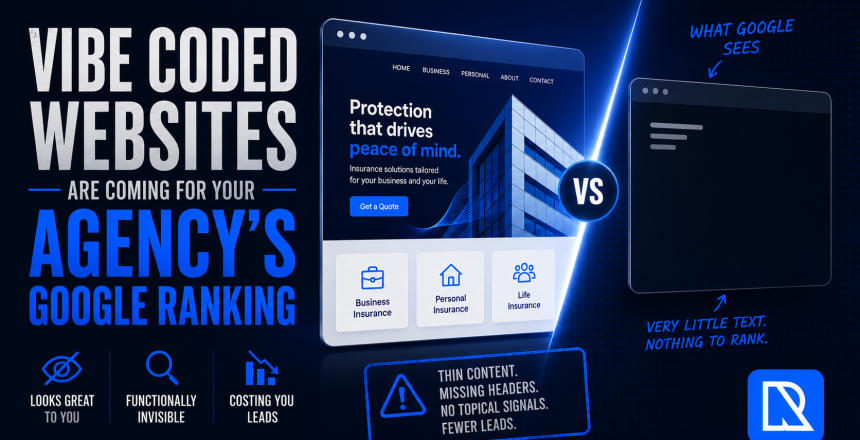
If you have been anywhere near the insurance industry tech conversation lately, you have probably heard the term “vibe coding.”
It means using AI tools to build a website fast. Drag and drop. Describe what you want. Hit publish. The site looks clean. It might even look great.
The problem is what is underneath it.
What vibe-coded sites get wrong
A website that looks good and a website that works for search are two different things. Most AI-generated sites are built for the visual layer. They are not built to communicate clearly to search engines.
When Google crawls your site, it is not looking at your color palette or your font choices. It is reading the text, the headers, the structure, the metadata, and the links. If those are thin or missing, Google has nothing to index.
The result is a site that looks polished but is functionally invisible.
For an independent agency, that invisibility costs you leads. Not tomorrow. Quietly, over time.
A quick test you can run right now
Here is a simple way to see how your site looks to a crawler.
Take your agency domain and paste it into this tool: https://urltomarkdown.com/
What you get back is a plain text version of your homepage. That is roughly what search engines see when they visit your site.
If you get back a wall of thin text, vague phrases, and no real structure, that is a problem. If you get back almost nothing, that is a bigger problem.
This is not a definitive SEO audit. But it is a useful gut check in about 30 seconds.
Why this matters more than people think
Agencies are not content companies. You are not spending your week writing blog posts and optimizing meta descriptions. You are taking calls, building relationships, and keeping clients from leaving after a hard renewal cycle.
So when someone hands you an AI-built website that looks the part, you take it. That is a reasonable decision.
The catch is that vibe-coded sites tend to share a set of structural weaknesses. Thin body content. Missing headers. No clear topical signals. Pages that describe what you do in three sentences.
Google rewards specificity. It rewards structure. It rewards pages that answer real questions with real depth.
Most AI-generated sites do not do that by default.
What to do about it
You do not need to scrap your site or start over. You need to audit what is there.
Start with that urltomarkdown.com test. Look at what comes back. If your homepage does not clearly communicate your location, your lines of business, and who you serve in plain text, it probably is not doing that for Google either.
Then go deeper. The team at Advisor Evolved published a thorough breakdown of vibe-coded websites in the insurance space. They cover the good, the bad, and the ugly in a way that is practical and worth your time. Read it here: https://advisorevolved.com/vibe-coded-websites-the-good-bad-ugly/
The point is not to be afraid of AI tools. The point is to understand what they are optimized for, and what they are not.
Your website is still a lead generation asset. It should work like one.
David Watson is the founder of RiskAdvisor, an intake platform built for independent personal lines agencies.