
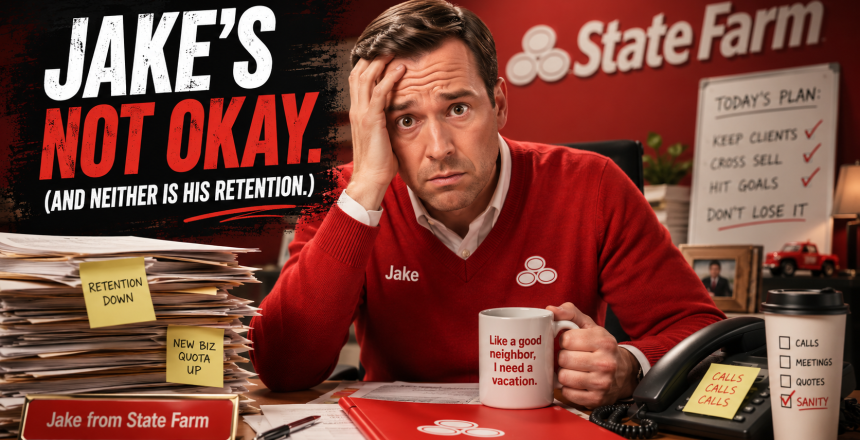
Everyone in the independent channel is watching the State Farm situation unfold. The forums are loud. The takes are everywhere. And the recruiting advice being passed around sounds like common sense: State Farm agents are unhappy, go get them.
That advice is mostly wrong.
State Farm Is Not Collapsing. It Is Sorting.
The agents getting squeezed out are not weak producers who fell behind. They are relationship-driven, service-heavy operators who built their entire model around one thing: keeping clients. High retention. Deep local trust. Low new business numbers.
That profile feels like a good hire. It is not.
An independent agency runs on carrier spread, appetite management, and multi-carrier quoting discipline. A captive agent who spent a decade winning on retention and brand recognition has not built those muscles. They built a different set entirely. Putting them in your shop and expecting production is not recruiting. It is wishful thinking.
I made this exact transition. When I left a captive environment and went independent, the two things that hit me hardest were not the ones I expected. The first was realizing I needed to collect far more than three or four pieces of information to actually quote a risk properly. The second was understanding that knowing which carriers would even want a given risk was its own skill set, one I had never needed before. The carrier had always handled that decision for me.
That gap is real. And it is not fixed by enthusiasm or industry experience alone.
The People Worth Recruiting Are Not the Agents
State Farm agents employ their own staff. Those team members are not State Farm employees. They are employed by the agent, which means their pay, their workload, and their job security are directly tied to that agent’s office margins.
State Farm is redesigning its economics around new business production and financial services output. Agents who built service-heavy offices are about to feel that in their margins. When margins shrink, the first thing that changes is staffing. Hours get cut. Raises stop. Good people start looking.
The team member who has been handling renewals, service calls, retention conversations, and cross-sell for five years inside a structured captive environment is not an agent who could not produce. They are a licensed, process-trained professional whose office is about to get harder to work in.
That is your candidate.
They already know how to work a process. They know how to handle hard customer conversations. They understand insurance at the line level. What they do not know yet is how an independent agency works. That is a training problem, not a character problem. And training problems are solvable, if your agency has the systems to do the teaching.
The Question Nobody Is Asking
If a licensed State Farm team member called your agency tomorrow and said they were ready to make a move, could you actually absorb them?
Not hire them. Absorb them.
There is a difference. Hiring means you gave someone a desk and a login. Absorbing means your operation has the structure to make a skilled but new-to-independent person productive inside weeks rather than months.
Most agencies cannot honestly say yes to that question. Not because they lack good people. Because the process lives in someone’s head rather than in a system.
What Ready Actually Looks Like
There are three things a well-run agency can hand a new team member on day one. If you cannot hand them all three, you are not ready to recruit. You are ready to frustrate someone who deserved better than their last situation.
A complete intake process. Independent agencies collect significantly more information than captive offices. Carrier applications ask about prior claims history, coverage gaps, property conditions, driver details, and risk characteristics that a single-carrier system either auto-populates or ignores entirely. If your intake process is not written down and does not tell a new person exactly what to collect and in what order, every new hire starts from scratch and learns by making mistakes on real clients.
Carrier fit guidance built into the workflow. One of the hardest adjustments coming out of a captive environment is learning that not every carrier wants every risk. In a captive shop, that decision is made for you. In an independent agency, it is a skill. Knowing which markets are open, which appetites match a given risk profile, and which submissions are likely to come back declined is knowledge that takes time to develop. If that knowledge lives only in a senior producer’s head, a new team member cannot access it when they need it. It needs to be part of the workflow.
A single record that does not require re-entry. Captive staff are accustomed to one system. Independent agencies often run several: a rater, an AMS, a CRM, sometimes a separate intake tool. If your new hire has to key the same client information into three different platforms to get a quote out the door, you have not given them a job. You have given them a data entry problem that will consume half their day and introduce errors at every transfer point.
The Agencies That Will Win This Talent
The independent agencies that come out of this moment with genuinely strong hires will not be the ones who moved fastest. They will be the ones who were already operationally ready before the opportunity showed up.
That means a repeatable intake process that collects complete risk information from the start. Carrier fit flagged before quoting begins, not after a submission gets declined. One record that flows downstream to your rater and your AMS without manual re-entry.
RiskAdvisor was built around exactly this problem. Structured intake. Carrier eligibility surfaced before the quoting conversation starts. One record that moves through your stack without duplication.
That is not a pitch for a new hire who already knows everything. It is the foundation that makes a skilled person productive quickly, whether they are coming from a captive shop or not.
If your agency is watching this State Farm situation and thinking about talent, the right first move is not to start calling frustrated agents. It is to make sure your operation is ready to receive someone worth having.