
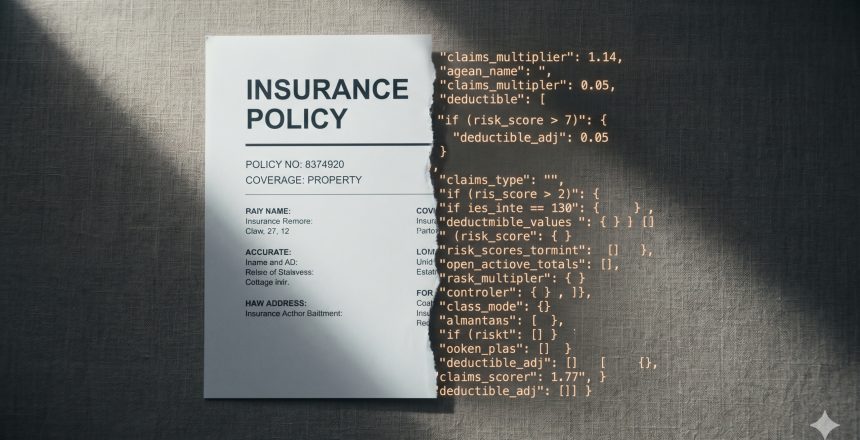
Insurance agencies have been building their own tools for years. Quote forms. Intake workflows. Client-facing chatbots. Eligibility logic that screens risks before they reach a producer.
What changed is how fast and easy it got. AI tools, no-code platforms, and off-the-shelf automation let an agency owner with no engineering background spin up a custom intake form in an afternoon.
That is genuinely useful. It also carries a risk most owners have not thought through. Standard agent E&O may not catch it.
What Agent E&O Was Designed to Cover
Traditional agent E&O covers professional mistakes. Failing to obtain requested coverage. Giving negligent advice. Making a placement error that leaves a client exposed.
The policy assumes a licensed professional is at the center of the interaction. Someone who counsels, advises, and places. When something goes wrong, the question is whether that professional exercised reasonable care.
That framework holds when the failure is clearly human. It starts to break when the failure is systemic, automated, or built into a tool the agency created itself.
Where the Gap Opens
An agency builds a client-facing intake form using AI-generated code or a no-code builder. The form goes live. It appears to work. Clients complete it, data flows in, quotes get generated.
But somewhere in the logic, a question was omitted. A field was mapped incorrectly. A conditional rule fires in a way that was never tested. A client gets bound on coverage that does not match their actual exposure.
That claim lands on the agency. And the question is no longer whether a producer gave bad advice. The question is whether the defect was a professional services error or a failure in a software product the agency designed and deployed.
That distinction matters. Many agent E&O carriers draw a line there. Professional services errors are covered. Software product defects are not. The territory in between is where claims get contested.
The Scenarios That Create Problems
Misquotes from automated logic If an AI-built quote engine miscalculates premium, skips an endorsement, or maps a client into the wrong risk class, the claimant can frame that as a professional failure. The insurer can argue the defect is in the tool, not in professional judgment. Whether it falls within agent E&O depends on the policy language and how the agency presented its services.
Coverage gaps from incomplete intake questions Intake forms built without formal review can omit key exposure questions. A homeowner with a home-based business. A contractor with equipment floaters. A client with vacation property. If the form never surfaced those exposures and no producer caught them, the claim will include a failure-to-identify argument. The question then is whether the omission was a professional error or a design flaw in the form itself.
Chatbot statements about coverage This is the most direct exposure. A chatbot that tells a client their policy covers a specific loss, when it does not, has made a misrepresentation. Courts are unlikely to be sympathetic to disclaimers when the agency is a licensed professional and the client reasonably relied on the tool the agency put in front of them.
Cyber Coverage Has Similar Gaps
Agent-built tools also carry data security risk that standard cyber policies may not cover cleanly.
Cyber policies cover incidents resulting from security failures. Unauthorized access. Data breaches. Ransomware. What they increasingly do not cover is incidents caused by poor coding practices the insurer can point to as a known risk.
Hard-coded credentials in form code. Exposed databases. API endpoints without authentication. These are common outputs of AI-generated or no-code tools built without engineering review. If a breach traces back to one of these issues, the cyber insurer may deny the claim on failure-to-maintain-security grounds.
The underwriting record also matters. If an agency attested on its cyber application that it follows secure coding practices and a breach later reveals DIY tools built without any review, the insurer has grounds to contest coverage or rescind the policy entirely.
The Role Creep Problem
When an agency builds tools it uses internally, it looks like an agent using technology to serve clients. When that same agency starts sharing those tools with other producers, licensing them to partner agencies, or embedding them in third-party platforms, it begins to look like a technology vendor.
That shift matters because tech E&O and agent E&O cover different things. An agent E&O carrier can argue that claims arising from a licensed or white-labeled tool belong under tech E&O, not under the agent’s professional liability policy. If there is no tech E&O policy in place, the coverage gap is real.
Most agencies do not think of themselves as software companies. If the tool you built is running on someone else’s platform or being used by someone outside your agency, regulators and plaintiffs may see it differently.
What to Do Now
Review your E&O policy language. Look specifically for exclusions related to technology services, software products, or AI-assisted activity. If your policy has any of those exclusions and your agency is using automated workflows to serve clients, talk to your broker about whether a manuscript endorsement is available.
Inventory what you have built. Any tool that touches client intake, coverage selection, eligibility screening, or client communication is a potential E&O or cyber exposure. List those tools and document what they do.
Ask how they were built and tested. If the answer is “we pasted something into ChatGPT and it seemed to work,” that is a documentation gap. At minimum, log when the tool was created, what it does, and what testing was performed.
Review your cyber application. Make sure any attestations about secure coding, code review, or change management are accurate relative to what your agency has actually deployed. Misstatements on the application are a claim denial waiting to happen.
Talk to your E&O broker. Not as a formality. As a substantive conversation about whether your current coverage responds to AI-assisted workflows, automated intake, and client-facing digital tools. The answer may surprise you.
The Practical Bottom Line
AI tools are not inherently dangerous. Used well, they reduce manual work, improve consistency, and give agencies an operational edge.
The risk is not the tool. The risk is treating the tool as a harmless side project rather than a component of your professional service. Your clients are relying on what your technology tells them. Regulators and plaintiffs will hold you to that.
Build with intent. Document what you deploy. Make sure your coverage stack reflects what your agency actually does.
If you want to talk through how RiskAdvisor approaches intake standardization and what that means for your operational risk, book a call at riskadvisor.insure.
David Watson is the founder of RiskAdvisor, a B2B SaaS platform built for independent personal lines insurance agencies. RiskAdvisor helps agency owners standardize the intake process, reduce producer variance, and connect front-end client intake to back-end agency systems.